

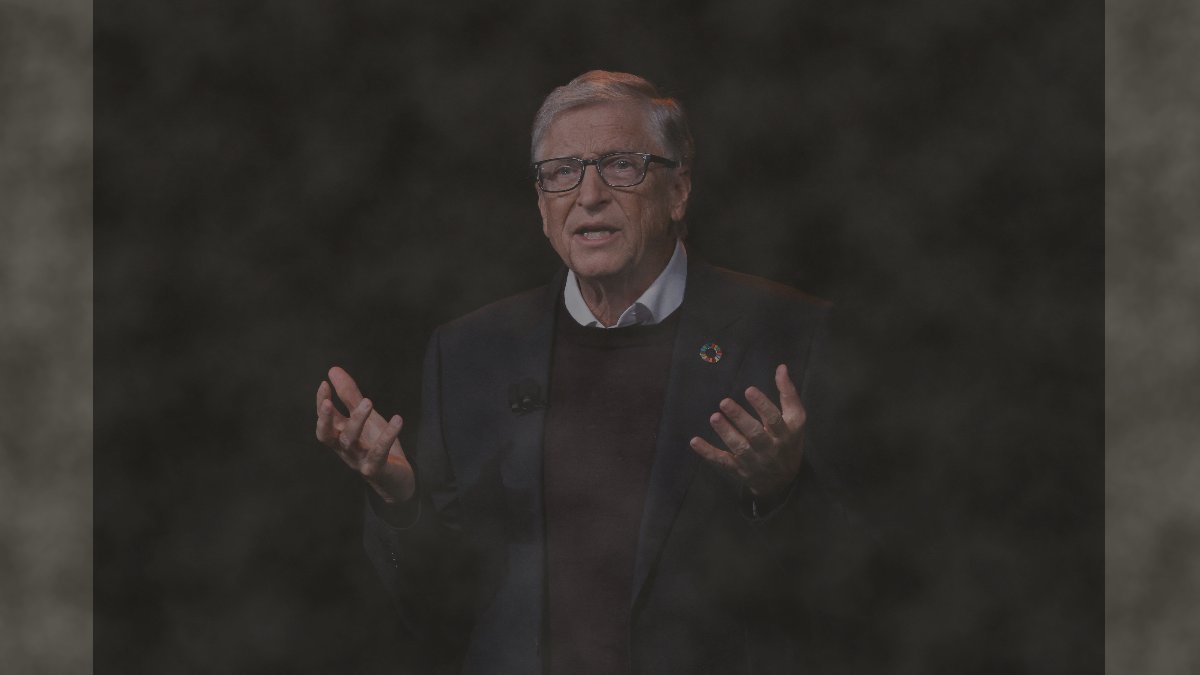
Bill Gates is warning that the technology already handling customer calls and bookkeeping entries could, within roughly two decades, be pouring concrete, tending crops and operating on patients. The Microsoft co-founder argues that the speed of that shift leaves little time to settle which tasks should remain in human hands and how the resulting gains ought to be divided.
His assessment spans both software and hardware. Today’s models absorb repetitive office work quickly and at lower cost, while machines steered by advanced software are expected to move into factories, fields, hospitals and building sites over the coming 20 years.
- Key Point: Gates expects AI-guided robots to take over physical labor in industry, agriculture, healthcare and construction across a roughly 20-year transition.
- Key Point: He argues the scarcity of white-collar skills could fade as models grow more capable, trimming headcount even where professions survive.
- Key Point: Gates wants some activities reserved for people, including childcare, food preparation, art and sport, to protect relationships and purpose.
- Key Point: Elon Musk agrees AI will remake employment but frames it as evolution, forecasting universal high income rather than only a basic one.
Office desks first, then machines that move
Gates points to the tasks AI has already colonized — telephone support, sales, administration and accounting — as an early signal of a broader transition. In an interview, he said the shortage of white-collar skills, meaning office roles built around analysis, management, support and the organization of information, could disappear once models reach higher capability. Automation, in his reading, would not erase whole professions so much as shrink the number of people each one requires.
The more difficult change involves robots able to travel through a space, interpret their surroundings and manipulate tools. For years such machines stayed inside factories, repeating predefined routines. Gates expects AI to release them from that confinement, allowing them to adapt to variable environments, follow multi-step instructions and carry out manual operations that today demand experience, strength, precision or a human supervisor.
“If we don’t decide to slow down massively or stop, we will have robots that can build houses, grow food, perform surgeries, and none of the things that human labor contributes to the economy will be necessary for most goods and services,” Gates said.
Surgery, liability and a two-decade runway
Medicine already relies on robotic systems as assistants in certain procedures, but the scenario Gates sketches assumes far greater independence. A machine cleared to cut and stitch would need rules covering safety, legal responsibility and clinical oversight. The question is not merely which tasks disappear, but who answers when something goes wrong and how patients are shielded.
He puts the adjustment period at about 20 years. Over that span, governments, employers and education systems would have to absorb jobs that vanish or mutate, with retraining, income protections and the division of productivity gains sitting at the center of the argument. Gates’ point is that the technology alone does not determine who benefits — that remains a social and political choice.
He also proposed fencing off certain activities for people even where a machine could handle them efficiently, naming childcare, food preparation, art and sport. Preserving a human presence there, in his framing, sustains relationships, a sense of purpose and social participation. The debate therefore runs past output per hour into which experiences a community wants to keep recognizably human.
Musk sees evolving roles rather than erasure
Elon Musk shares the premise that AI will remake the labor market, though he casts it as evolution rather than elimination. “Jobs are going to change. They always have,” he told journalists at the White House. He likened the shift to the disappearance of manual calculation, noting that digital computers now handle that work and that few people would want to spend their days on it again.
Musk foresees new roles forming and points to what he describes as an era of abundance driven by robots and superintelligence. “We won’t just have universal basic income, but universal high income,” he said. Gates, for his part, keeps returning to an unresolved question: what place people will hold once machines can produce goods and services at scale.
The practical tests will arrive well before humanoid builders reach a jobsite. Liability rules for autonomous surgery, retraining pipelines and the way machine output is taxed are policy decisions that no laboratory can make, and the 20-year horizon Gates describes compresses the window for making them. Companies rolling out automation today are already confronting the office-side version of that question, which suggests the argument over what stays human will be settled incrementally rather than all at once.