

Google’s orbital data-center experiment has started talking back. Engineers beamed a request to the Suncatcher satellite asking it to compose a haiku about space, and the Gemma 4 model running aboard produced a reply that reached the ground on October 30, the company said. The exchange happened as the spacecraft passed over Svalbard, Norway.
- Key Point: The Suncatcher prototype returned its first AI-generated output from orbit on October 30, answering a prompt to write a haiku about space.
- Key Point: The satellite carries four of Google’s tensor processing units and can generate up to 1 kilowatt of electricity, enough to run one chip for roughly 20 minutes at a time.
- Key Point: Google launched the spacecraft on October 1 on a SpaceX Falcon 9 alongside more than 100 other satellites, then spent about three weeks checking its systems.
- Key Point: If the hardware holds up, two TPU-equipped satellites are slated for 2027 with more power and optical links between them.
A poem, then technical questions
The verse Google received reads:
Blue marble below / Data streams in silent grace / Starlight feeds my core
After the poem, the team moved on to five-line limericks about space and to queries about the condition of the equipment itself. Travis Beals, a senior director overseeing the project, described the milestone as a “Hello World” moment, a reference to the customary first test of a new computing system.
Gemma 4 is an open model from Google DeepMind, the company’s artificial intelligence lab, and was loaded onto the satellite before launch. A Google spokesperson said the spacecraft is operating normally.
Power limits and a harsh environment
The payload consists of four tensor processing units, the AI chips Google designs in-house, drawing on a power budget of up to 1 kilowatt. That supply is enough to keep a single chip running for only about 20 minutes continuously, which also complicates maintaining a link with Earth.
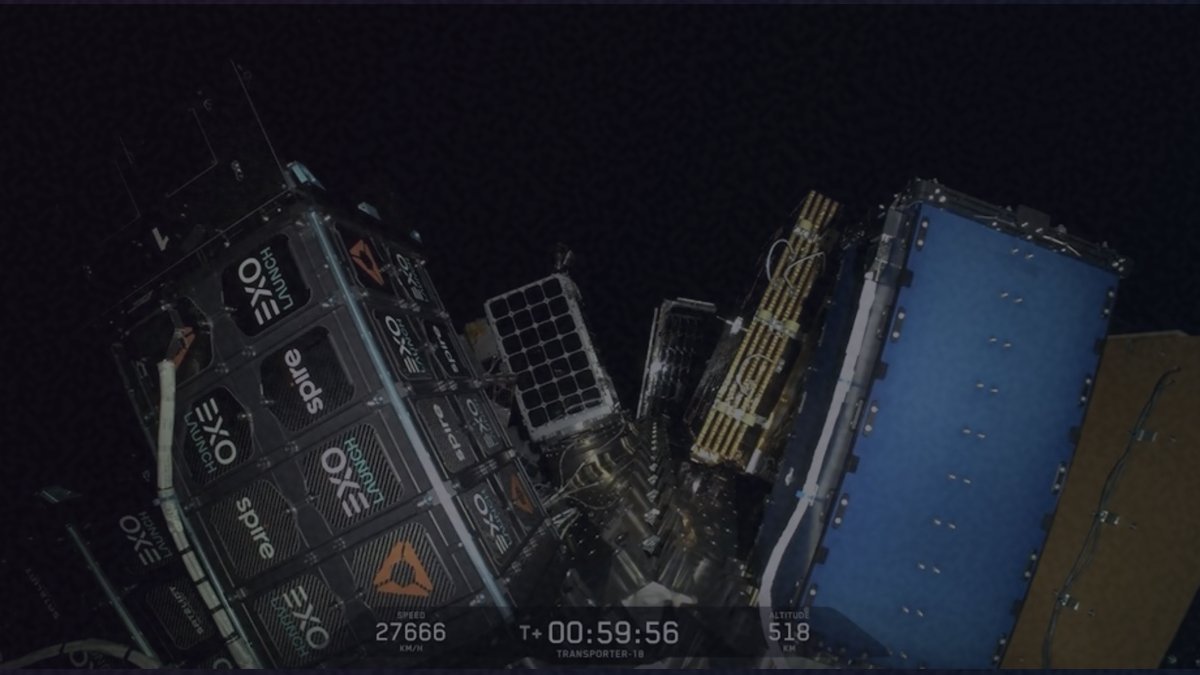
Google frames the mission as an early step toward clusters of satellites flying in close formation and handling demanding AI workloads in orbit. The spacecraft lifted off aboard a Falcon 9 with more than 100 other vehicles.
What comes next is a durability test. Upcoming trials will measure how the chips perform under thermal stress and exposure to space radiation, which can corrupt memory and alter data without tripping the usual control systems. Ground testing suggested the effect is modest when a model is used for inference and more troublesome when one is being trained.
Two satellites and a laser link in 2027
Should the chips prove resilient, Google plans to send up two TPU-bearing satellites in 2027. Those spacecraft would carry more power-generation capacity and would test optical links between them, meaning direct light-based communication from one vehicle to another.
Suncatcher stands apart from other space data-center proposals in planning high-speed inter-satellite connections. SpaceX’s data-center satellites would also use lasers, but they would orbit too far apart to share processing work. Starcloud and Cowboy Space, by contrast, are pursuing AI tasks on individual satellites.
Launch economics tie the effort to SpaceX. Alphabet, Google’s parent company, holds a significant stake in SpaceX, and both companies would need Starship, the heavy rocket still in development, to put data centers in orbit at workable cost. A peer-reviewed analysis published this month estimated that SpaceX would have to fly Starship 1,800 times to match the cost reductions it achieved with earlier rockets.
The milestone lands in a difficult week for Alphabet: its shares fell after the company reported that AI features in its search engine are slowing growth in advertising revenue. For Google, the Suncatcher result is a narrow technical proof rather than a commercial product, but it establishes that a data-center-grade AI chip can execute a prompt in orbit and return an answer. The radiation and thermal data gathered over the coming months will determine whether that demonstration scales into the networked satellite architecture the company has sketched for 2027.