

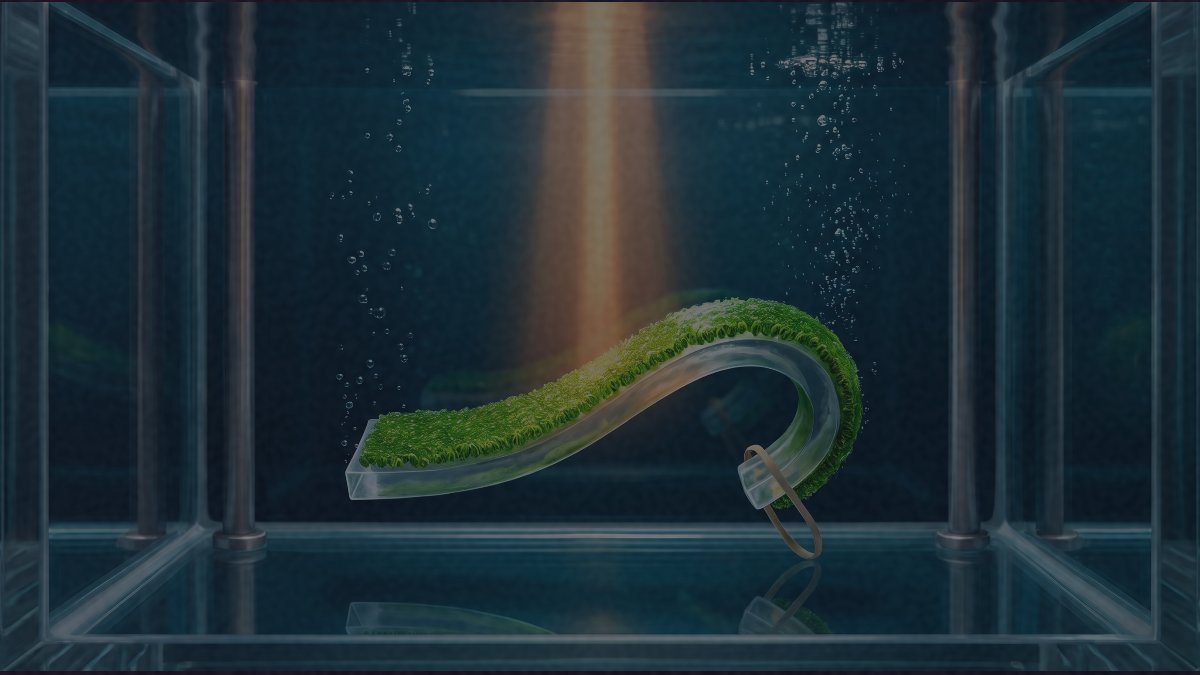
A soft robotic strip barely two centimeters long can curl, grip and release objects using nothing but living microalgae and changes in illumination. Engineers at Delft University of Technology (TU Delft) in the Netherlands built the device, which carries no motor, cable or battery, and reported the results in Nature Communications.
- Key Point: The actuator measures about 2 centimeters long and 1 millimeter thick, and its motion comes entirely from the photosynthesis and respiration cycle of algae growing on its surface.
- Key Point: Switching light on and off shifts the local acidity inside the hydrogel, producing a bend of up to 300 degrees that reverses within about 10 seconds.
- Key Point: Prototypes included a hook that held and freed a 52.5-milligram rubber band, a four-fingered gripper and a flower-shaped model that opens in light and closes in darkness.
- Key Point: The organisms are not genetically modified, and the pH changes stay confined to the gel rather than altering the surrounding liquid.
A biological engine inside a two-layer gel
The core idea is that the algae themselves do the work. When illuminated, the single-celled freshwater species Chlamydomonas reinhardtii photosynthesizes and raises the pH level; in the dark, cellular respiration releases carbon dioxide and pushes it back down. That purely biological oscillation drives the mechanical response.
The strip is made of two hydrogel layers, a flexible, porous material that holds a high concentration of water. One layer reacts to acidity by swelling or contracting, while the other stays inert. Because the two respond differently to the same cue, the assembly curves, much as a bimetallic strip warps when heated.
Fan Jiang, lead author of the study and a researcher in TU Delft’s Department of Bionanoscience, described the construction in a press statement:
Our proof-of-concept actuator is a soft green strip made of two different hydrogel layers, with microalgae growing on its surface. When exposed to changing light conditions, the strip can bend back and forth.
Jiang added that the layers swell to different degrees as acidity shifts, and that the strip begins reversing direction quickly once the lighting changes.
Within 10 seconds the actuator already starts bending in the opposite direction.
Under illumination the local pH inside the material climbs from roughly 8 to above 10, according to the study. That shift yields the 300-degree curvature, and the device ran for at least 10 consecutive cycles without a significant loss of range.
Demonstrations point to underwater and agricultural uses
The team validated the concept with several working prototypes rather than a single test piece. Beyond the hook that grabbed and released the rubber band, they built a four-finger clamp and a flower-like structure that unfolds under light and folds shut when darkness returns.
One property matters for wet environments: the actuator leaves the acidity of the surrounding fluid untouched, because the chemical changes occur locally within the hydrogel. Other pH-driven systems require altering the whole medium, which limits where they can operate. The forces produced are in the range typical of soft devices designed to handle small, delicate items.
Marie-Eve Aubin-Tam, the project’s principal investigator at TU Delft, framed the long-term appeal around self-sufficiency:
Microalgae are plant-like organisms that are largely self-sufficient. They use light as an energy source through photosynthesis, which gives the actuator the potential to operate for a long time with minimal external input.
Because the algae are unmodified, the paper argues that the movement arises from natural photosynthesis, allowing direct harvesting of solar energy while carbon dioxide is captured at the same time. Unlike laboratory-engineered organisms, the strain used raises no biosafety concerns if released into the environment, the authors state.
The study also notes that C. reinhardtii tolerates variations in temperature, salinity and light intensity, a trait that could make the device more resilient outside controlled conditions. The researchers single out underwater robotics and agricultural automation as the most promising settings, while cautioning that the system remains a prototype and that practical deployment will require further steps.
What comes next
The work sits at the intersection of materials science and synthetic biology, and its significance lies less in the current prototypes than in the control strategy: light replaces wiring as the on-off switch. Scaling the approach will depend on sustaining algal activity over long periods, improving the force the strips can exert and showing that the material holds up in real water and soil environments. Until those questions are answered, the device stands as a proof of concept for machines that borrow their power from living cells rather than from a battery.